The Death of the Masterpiece: The Future of AI Art
Updated October 27, 2026
The Death of the Masterpiece: The Future of AI Art
The masterpiece isn't dead because artificial intelligence can make one. It's dead because artificial intelligence can make a million.
For centuries, the art world has operated on a remarkably durable proposition: an artist makes something, the world looks at it, and eventually somebody decides what it's worth.
A canvas. A sculpture. A photograph. An object.
The artist's struggle, failures, experiments, and discarded ideas disappear into the background. What survives is the finished thing, hanging on a wall with a small label beside it.
We have become so accustomed to this arrangement that we rarely question it.
We should.
Because artificial intelligence has just exposed something the art world would rather not acknowledge: the finished image was never the whole story. It was simply the part we could sell.
And now that machines can produce extraordinary images in seconds, the entire arrangement is beginning to look absurd.
Beauty Has Become Cheap
Here is an uncomfortable fact.
A person with no drawing ability, no understanding of perspective, no knowledge of color theory, and no meaningful artistic ambition can generate an image of astonishing visual sophistication.
Not occasionally. Thousands of times a day.
The image might resemble a lost Renaissance masterpiece, a cinematic photograph, or an abstract painting that would look perfectly respectable in a Chelsea gallery.
And the next image might be even better.
This is a catastrophe for anyone whose definition of artistic achievement begins and ends with the appearance of the finished work.
When beauty becomes infinitely reproducible, beauty alone becomes a poor measure of value.
That doesn't mean beauty is unimportant. It means beauty is no longer sufficient.
The uncomfortable question is no longer whether AI can make something beautiful.
Of course it can.
The question is whether anybody should care.
The Art Market Has Been Selling the Wrong Thing
Consider what happens when a painting sells for $20 million.
The buyer isn't paying for canvas, pigment, or even visual pleasure. There are thousands of equally beautiful paintings available for a fraction of the price.
The buyer is purchasing a story.
Who made it? When? Under what circumstances? What did it mean in the artist's development? What risks were taken? What changed because it existed?
The art market has always understood this, even while pretending that the object itself possesses some mysterious intrinsic value.
A Picasso is not valuable merely because it looks like a Picasso. It's valuable because Picasso made it, at a particular moment in a particular life, as part of a particular artistic revolution.
The image is evidence of something larger.
Artificial intelligence forces us to confront that distinction.
If a machine can produce a convincing Picasso-like image in fifteen seconds, the visual characteristics of a Picasso are no longer scarce.
What remains scarce is the history of Picasso becoming Picasso.
The future of art belongs less to the image than to the evidence of becoming.
Duchamp Was Right. We Just Didn't Go Far Enough.
In 1917, Marcel Duchamp submitted an ordinary urinal to an art exhibition and called it Fountain.
The scandal wasn't the plumbing.
The scandal was the proposition that artistic value could exist independently of traditional craftsmanship.
The act of choosing, relocating, naming, and presenting an object could itself constitute art.
Much of the art world spent the following century arguing with that proposition while quietly absorbing it.
Conceptual art, performance art, process art, installation art, and countless other movements gradually expanded what an artwork could be.
Sol LeWitt made instructions central to the work. John Cage challenged the assumption that composition required conventional musical control. Jackson Pollock made the physical act of painting inseparable from the resulting image.
These artists were dismantling the supremacy of the finished object long before artificial intelligence arrived.
But AI may finish the job.
Duchamp showed that the artist didn't necessarily have to manufacture the object.
AI now shows that the object doesn't necessarily have to be the artwork.
That is a much more radical proposition.
The Prompt Is Not the Artwork Either
There is a temptation among AI enthusiasts to replace one simplistic idea with another.
If the image isn't the art, perhaps the prompt is.
No.
Typing "a beautiful woman in the style of Gustav Klimt" is not a profound artistic achievement, regardless of how impressive the resulting image might be.
Nor does adding 200 adjectives magically transform the exercise into an act of genius.
A prompt is an instruction. Sometimes a sophisticated one. Sometimes an imaginative one. Often a remarkably ordinary one.
The artistic act begins when the creator starts making consequential decisions.
Why this image rather than that one?
What is missing?
What happens if the subject disappears?
What if the composition is destroyed and rebuilt?
What if the most interesting result is an accident?
What if the machine's interpretation is more compelling than the original intention?
And what if the artist deliberately follows that unexpected direction instead of correcting it?
Now something interesting is happening.
Not because the machine is making pictures.
Because a human intelligence is engaging with an unpredictable creative system, making judgments, taking risks, rejecting easy answers, and allowing the work to evolve beyond its initial conception.
The artist is no longer simply the maker of an image. The artist becomes the architect of a creative journey.
Imagine a Museum That Exhibits the Entire Journey
Picture walking into a museum in 2035.
On one wall hangs a spectacular AI-generated image.
You admire it for thirty seconds and move on.
You've already seen thousands of spectacular AI images. One more barely registers.
But in the next room, something different is happening.
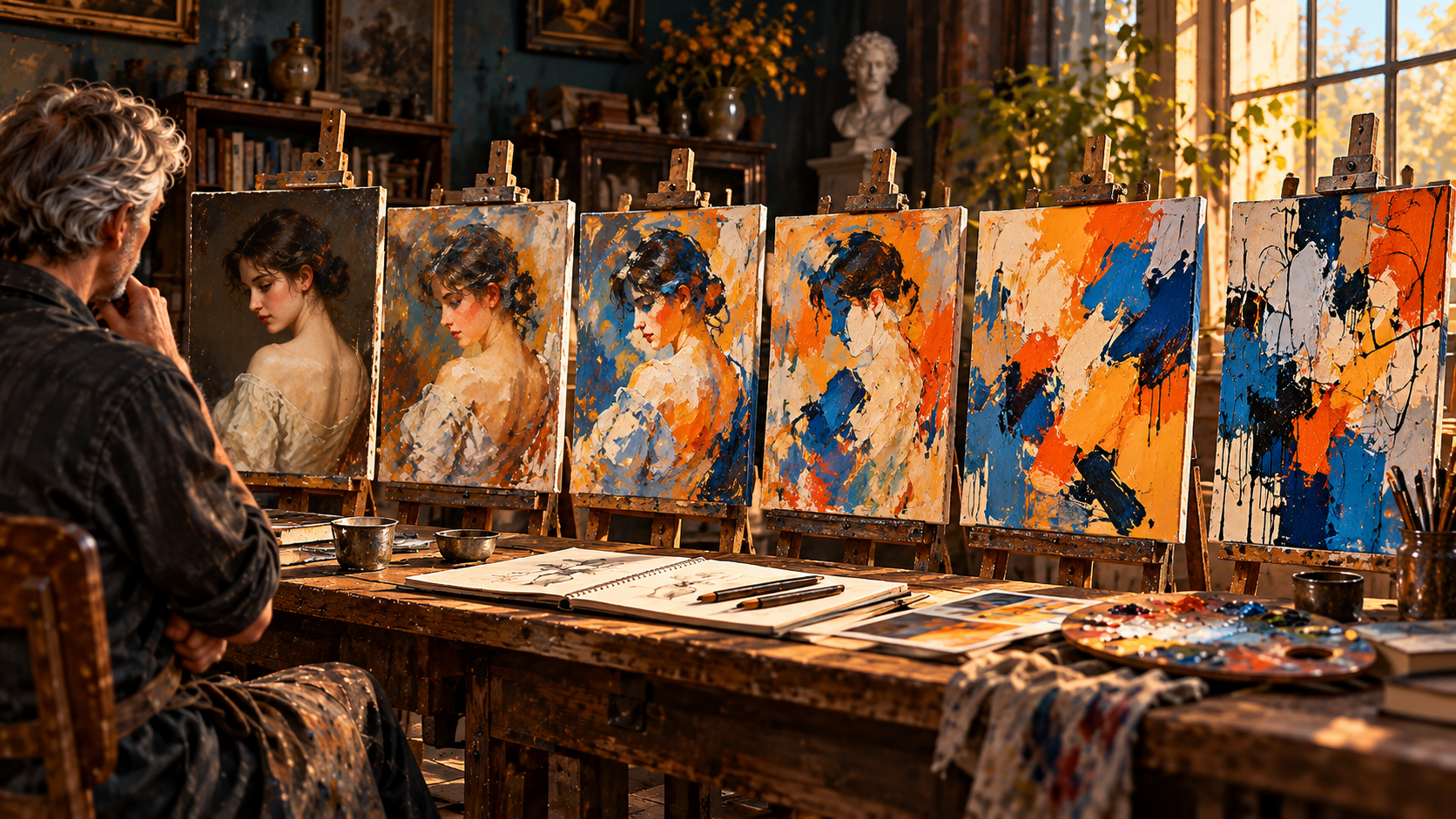
You encounter an artwork that began as a conventional portrait.
You watch it evolve through fifty generations.
At first, the changes are subtle. Then the composition fractures. The face disappears. Colors become violent. Figurative elements dissolve into abstraction. The work takes an unexpected turn toward something almost architectural.
Some generations are failures.
Some are beautiful but uninteresting.
One is an extraordinary accident.
The artist rejects it.
Why?
You discover that the artist is pursuing something more difficult than beauty: an unresolved visual tension that has been emerging throughout the process.
You see the alternatives that were discarded, the aesthetic judgments that redirected the work, and the moments when the artist surrendered control to the system.
Eventually, the process arrives at a final image.
But by then, the final image is almost beside the point.
You've witnessed an artistic intelligence making choices.
You've seen uncertainty, discovery, obsession, and judgment.
You've experienced the creation of the work, not merely its conclusion.
Which room contained the more significant artwork?
I would argue the second.
And I suspect future generations will wonder why we spent so long treating the first as the only legitimate form.
The New Masterpiece May Be a Lineage
In evolutionary biology, the final organism cannot be fully understood without its ancestry.
Something similar may become true of generative art.
An artwork can begin with an initial image, evolve through multiple generations, branch into competing possibilities, and undergo selection based on aesthetic criteria.
The process can be guided by human judgment, algorithmic criticism, chance, or some combination of all three.
Each generation contains evidence of what came before.
Each rejected alternative reveals something about the direction of the work.
The result is not merely an image.
It is a lineage.
And that lineage may possess qualities no individual image can communicate: struggle, development, contradiction, surprise, and the emergence of something that nobody anticipated at the beginning.
This is particularly interesting when artificial intelligence participates in evaluating the work.
Imagine different critical systems applying radically different aesthetic priorities. One rewards formal discipline. Another favors emotional intensity. A third seeks conceptual disruption.
The same starting image could evolve into entirely different artistic families depending on which critical philosophy guides its development.
Now the artist is doing something fundamentally different from producing pictures.
The artist is designing the conditions under which art can emerge.
That is not a lesser form of authorship.
It may be a more intellectually demanding one.
But There Is a Catch: Most AI Art Is Still Garbage
Let's dispense with the polite fiction that technological sophistication automatically produces artistic significance.
It doesn't.
Most AI-generated imagery is decorative noise.
Beautiful faces. Impossible landscapes. Glowing cities. Elaborate fantasies. Endless variations on images we've already seen.
Much of it is visually accomplished and artistically empty.
The problem isn't that machines are involved.
The problem is that nobody is making interesting decisions.
And recording the entire process doesn't magically fix that.
A thousand mediocre generations do not constitute a masterpiece any more than a thousand photographs of someone's lunch constitute a documentary.
A lineage is only meaningful when the choices within it are meaningful.
There must be an idea worth pursuing, a willingness to abandon attractive dead ends, and some evidence of an aesthetic intelligence that knows the difference between novelty and significance.
Otherwise, we're simply replacing mountains of disposable images with mountains of disposable process documentation.
That would be progress only in the storage industry.
The Collector of Tomorrow Won't Just Buy the Picture
If this argument is correct, the art market faces a serious problem.
How do you collect an artwork whose essential identity includes its entire creative history?
The answer is not necessarily an NFT, a blockchain certificate, or another elaborate mechanism for manufacturing digital scarcity.
Scarcity alone doesn't create artistic value.
The more interesting possibility is that collectors will acquire complete creative works: the initial concept, the evolutionary record, significant branches, the artist's interventions, the critical framework, and the final selected result.
The artwork becomes a documented intellectual and aesthetic event.
Its authenticity rests not simply on whether a particular image is original, but on whether the creative history is genuine, coherent, and attributable.
A collector might own a beautifully produced physical artifact accompanied by its complete digital lineage.
A museum might exhibit the evolutionary process alongside selected physical works.
A scholar might study the decisions that shaped the outcome rather than merely analyzing the finished composition.
And an auction house might eventually describe a work not simply as "AI-generated image, 2029," but as an evolving creative system with a documented history of artistic decisions.
Some of these possibilities will undoubtedly become commercial gimmicks.
Others may establish an entirely new category of collectible art.
The distinction will depend on whether the process itself deserves our attention.
The Myth of the Solitary Genius Is Also in Trouble
There is another reason this development makes people uncomfortable.
For centuries, we have romanticized the artist as a solitary genius imposing a personal vision upon passive materials.
But materials have never been entirely passive.
Paint behaves unpredictably. Clay collapses. Photographic chemistry produces accidents. Printing techniques introduce surprises.
Artists have always negotiated with their tools.
AI simply makes that negotiation more visible, more complex, and occasionally more intelligent.
A generative system can propose alternatives the artist would never have imagined.
It can challenge a composition, introduce unexpected relationships, or move toward aesthetic territories outside the creator's established habits.
The human artist must decide whether those developments are worth pursuing.
That doesn't eliminate authorship.
It changes where authorship resides.
The important distinction is no longer between an image made by a human and an image made by a machine.
It is between a creative process governed by meaningful artistic judgment and one that merely produces outputs.
Some human-made art fails that test.
Some AI-assisted art may pass it brilliantly.
The medium isn't the verdict.
Stop Asking Whether AI Can Make Art
It's the wrong question, and frankly, it's becoming a boring one.
The more interesting question is what kind of art becomes possible when the artist no longer needs to spend most of the creative process physically manufacturing the result.
What happens when artists can explore a hundred visual directions instead of three?
When they can preserve every significant decision?
When an artwork can expose its own history?
When the act of selection becomes as important as the act of production?
When the audience can experience not only what an artist created, but how an artistic idea struggled into existence?
These are not merely improvements in efficiency.
They suggest a different conception of the artwork itself.
And the implications extend well beyond artificial intelligence.
Painting, sculpture, photography, filmmaking, and even architecture may increasingly treat the history of creation as part of the work rather than disposable preparation for it.
The finished object won't disappear.
There will always be extraordinary paintings, photographs, and sculptures that deserve to stand alone.
But the assumption that the finished object must be the primary artistic achievement is becoming harder to defend.
And good riddance.
The Masterpiece Is Dead. Long Live the Masterpiece.
We are approaching a moment when anyone can generate a beautiful image.
Soon, the ability to produce one will be about as remarkable as the ability to take a photograph.
That doesn't mean photography ceased to be art.
It means pressing the shutter was never enough.
AI art faces the same reckoning.
The artists who matter won't necessarily be the ones producing the most impressive images. They'll be the ones asking the most interesting questions, building the most compelling creative systems, making the most consequential choices, and taking us somewhere we couldn't have predicted.
Their greatest works may not be single pictures at all.
They may be histories of discovery.
The discarded versions. The unexpected branches. The failures. The interventions. The arguments between human intention and machine possibility.
The entire improbable journey from an ordinary beginning to something genuinely worth seeing.
For five hundred years, we've walked into museums and admired the destination.
It's time we started collecting the voyage.
#AIArt #GenerativeArt #FutureOfArt #EvolutionaryArt #AIArtists #ComputationalCreativity #ArtAndTechnology #CreativeProcess #DigitalArt #ConceptualArt #ArtificialIntelligenceArt #ArtisticEvolution #AIArtRevolution #ArtFaux #ChezArte