When AI Art Leaves the Screen
The first time a computer produces a convincing painting from a few words, it feels like a small miracle. After the thousandth time, you start asking a more interesting question: what is all this image-making going to become?
I doubt the most consequential answer is another screen, a moving picture or an artwork that responds when someone waves at it. Those forms will continue. My strongest bet is that AI will become part of how we make physical art and develop an individual artistic language.
That is a forecast, not an established destination. But there are already signs of it.
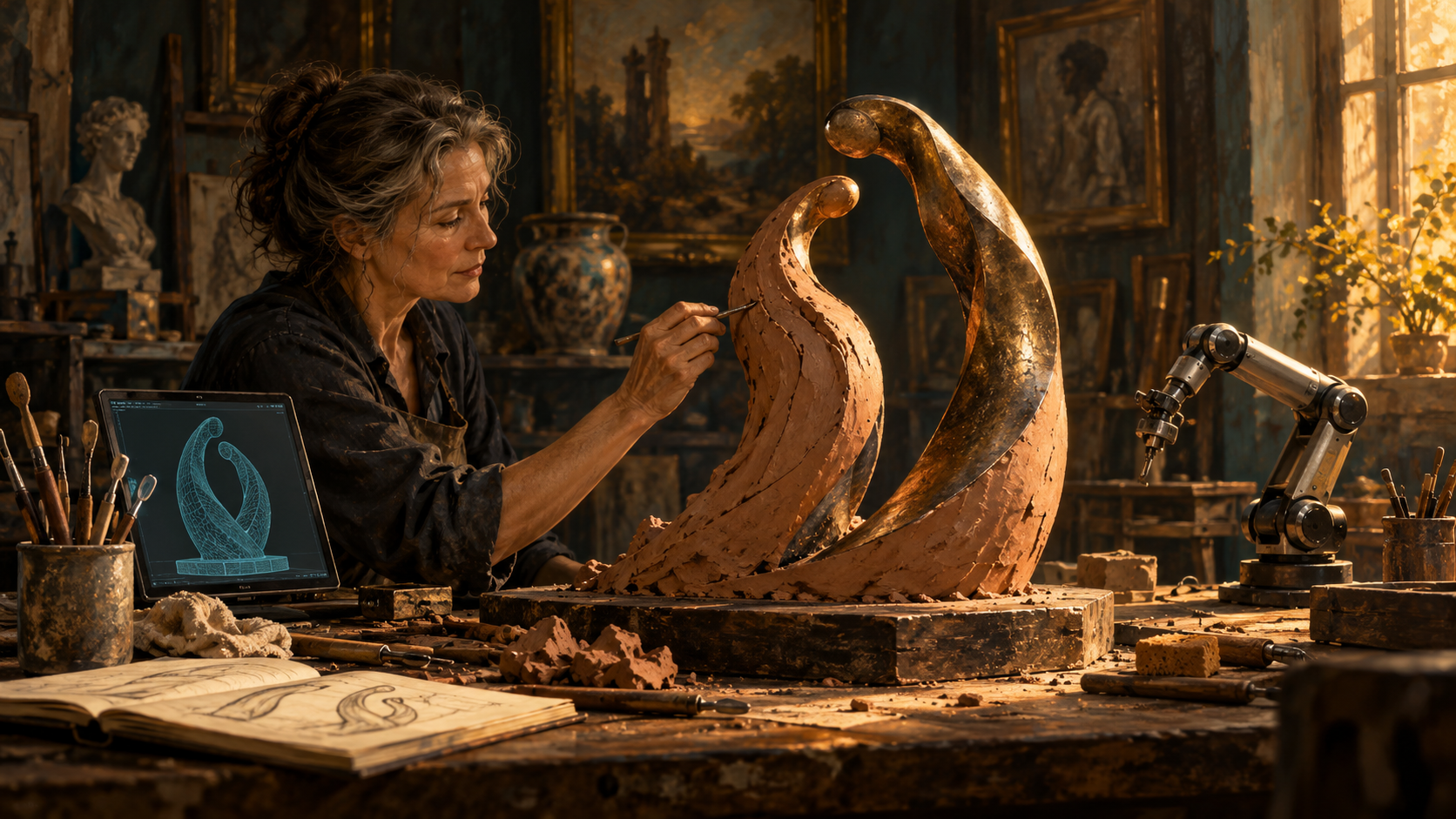
Over the next five to ten years, I expect more artists to use AI to develop work that eventually takes shape in paint, clay, metal, glass or fabric. The computer will be somewhere inside the process. The thing we live with will have a physical presence.
An artist’s own way of thinking
Today, much AI image-making starts with a general-purpose model and a description of the desired result. The next stage could involve systems built around a particular artist’s work: their drawings, photographs, recurring subjects and decisions about what succeeds.
An artist could adapt a model using material they own or have permission to use, then develop it through years of experimentation. Commercial models would often remain underneath. But the artist’s accumulated choices could give the work a recognizable character.
Imagine someone working on grief. They begin with family photographs, sketches of empty rooms and memories written in a notebook. AI helps them explore compositions and forms. They revise some, combine others and discard most. Eventually, one idea becomes a ceramic sculpture.
The meaningful achievement is the work that emerges from those decisions. Having a personal model would not, by itself, establish originality or authorship.
I also expect more creation to happen through repeated experiments. An artist might generate variations, change the rules and use the results to begin another round. Software could help compare structure, color or resemblance. Whether the work says anything worth hearing would still require judgment.
A system trained to please its own scoring rules could become very good at producing the same successful emptiness.
Giving the work a body
The physical direction is already visible. Sougwen Chung has worked alongside drawing robots, including a system trained on two decades of their own artwork. The [Victoria and Albert Museum](https://www.vam.ac.uk/info/collection-selection-boxes-artificial-intelligence) acquired a resulting drawing, a version of the model and a video documenting the process.
That combination matters. It preserves both an object and evidence of how it came into existence.
I expect such practices to spread into sculpture, textiles and other material forms. AI could propose a structure or pattern that an artist develops with a fabricator, a loom or a robotic tool. Sometimes the machine would handle production. Sometimes a craftsperson would interpret its proposal.
There is considerable work between a convincing digital design and a successful object. Clay shrinks. Glass breaks. Pigments behave differently under different light. Materials impose conditions that an image generator can ignore.
Those conditions could become part of the artistic opportunity. Imagine a sculpture whose shape emerged through hundreds of computational experiments, then changed again because its maker found that the bronze needed a different balance. Its history would include both calculation and contact with matter.
Putting an AI image on canvas would remain an option. But a physical artwork could also develop in ways that were never fully present in the original image.
Who will buy it?
My expectation is a market with several overlapping levels.
At the inexpensive end, AI will probably increase the supply of decoration. Buyers will have abundant choices, and sellers of interchangeable images will face pressure on prices. A pleasant picture can find a customer. Supporting a business with it may become harder.
A more promising commercial area could be commissioned work with personal significance: portraits, family histories, memorial pieces and objects made for a particular place. Here, the artist’s ability to listen and interpret could matter as much as technical production. Buyers would be paying for a relationship to the work, along with its appearance.
The fine-art market would remain smaller and more selective. Collectors would consider the artist’s reputation, the strength of a body of work, exhibition history, provenance and scarcity. AI involvement would be one fact among many.
There is evidence of collector interest. Christie’s AI-focused Augmented Intelligence auction [totaled $728,784 in March 2025](https://press.christies.com/augmented-intelligence-totals-728784/). That establishes a market for some work. One auction cannot tell us what most AI artists will earn or whether buyers will return.
Nor does technological change automatically erase familiar collecting habits. The [2026 Art Basel and UBS survey](https://www.artbasel.com/stories/from-ai-to-gen-z--everything-you-need-to-know-about-the-2026-survey-of-global-collecting) found that paintings remained the most common starting point among the wealthy collectors surveyed.
I suspect successful AI artists will eventually be discussed primarily through their work. Collectors will care about what an artist has accomplished with the technology, just as they care about what a photographer accomplishes with a camera.
What counts as an original?
A digital file can be copied. A physical object can be reproduced. Calling either one “unique” needs an explanation.
I expect serious artists to become more precise about what they are offering: a single physical work, a declared edition, a digital master or rights to use a particular system. Collectors will need to know whether further versions can be made and who controls that decision.
Some museums may also collect the model and working process. The V&A acquisition already points in that direction. Preserving such work would require software, instructions and clear limits on future use. A model that keeps changing raises a difficult question: which version is the work?
A numbered certificate can help establish an edition. It cannot make an unlimited production process scarce unless the artist actually honors the limit.
Authentication will need a history
The useful question will be: can we verify that this is the work the artist says it is, made through the process they describe?
My expectation is that authentication will combine studio records with digital evidence. Artists could retain source material, important intermediate versions, model details and records of their own alterations. Fabricators could document production. Physical works could carry identifying marks and be linked to detailed photographs, edition records and a chain of ownership.
(https://spec.c2pa.org/specifications/specifications/2.4/explainer/Explainer.html), already offer a way to attach signed, tamper-evident statements about a digital file’s origin and editing history. They help verify the integrity of recorded information. They do not independently establish that every statement is true, settle ownership or prove that the underlying materials were lawfully used.
A digital record also needs a reliable connection to the physical object. A QR code stuck to a frame is easy to copy. Authentication will still depend on trustworthy people, sound records and examination of the work itself.
Copyright is a separate issue. In the United States, the [Copyright Office’s current position]
(https://www.copyright.gov/newsnet/2025/1060.html) centers on human authorship. Prompts alone do not provide sufficient control over expressive elements; human-created material, creative arrangements or modifications may qualify for protection, depending on the work.
Owning an authenticated object and owning its reproduction rights are different things. Buyers will need that distinction explained plainly.
I expect the strongest AI art to emerge from artists who develop a sustained practice, accept the difficulties of making things and keep an honest account of their contribution.
The tools will become more capable. That part seems likely. Whether the resulting work deserves a place in someone’s home, a gallery or a museum will remain a much harder test.
I would like to see AI help people make things they could barely imagine before, then give those things enough substance and meaning that someone wants to keep them.